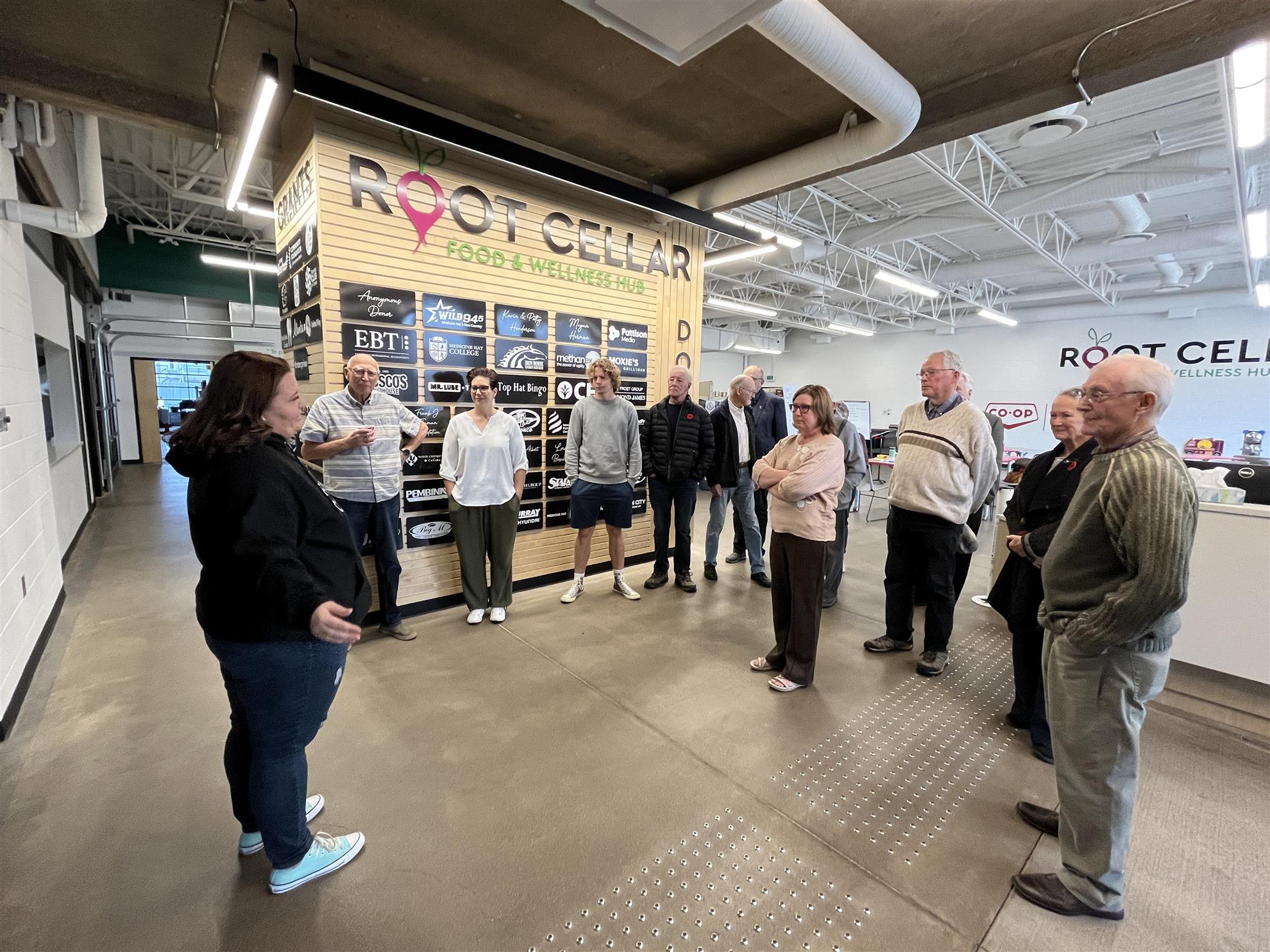
This was a Rotary Club of Medicine Hat Monday noon meeting with a difference! We could not have spent our time in a better way! We met at the Root Cellar (440 Maple Ave SE, Medicine Hat) and had the pleasure of ED Melissa Mullis taking us on a tour of the different sections of the Cellar and filling us in about the amazing work done by the Cellar staff and volunteers. This was an hour so well spent!
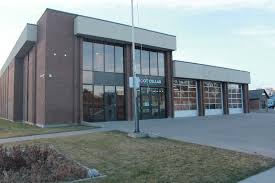
Established in 1992, the Medicine Hat Root Cellar (at that time called the Food Bank) moved to Maple Ave four years ago – into what used to be a Fire Station. More room was needed, not only for food storage but for other services. The exciting news is that the building is going to be extended at the back to provide another warehouse. Fundraising will be done, in due course.
The reason for the name change – from Food Bank to Root Cellar – was because they wanted to get rid of the stigma that had developed around the name ‘Food Bank’ and to indicate that they try to get to the root of why people are needing food, offering a range of services to help people become self-sufficient, as far as possible.
The Medicine Hat Root Cellar is one of 110 Food Banks in Alberta and Melissa Mullis is in fact the chair of the Alberta Association of Food Banks.
Mission Statement
“The Root Cellar Food and Wellness Hub is the next step in the evolution of a strong and sustainable city. Our mission is to build community by improving the lives of all community members through the power of local food”.
On entry, one takes in a wall of donors.
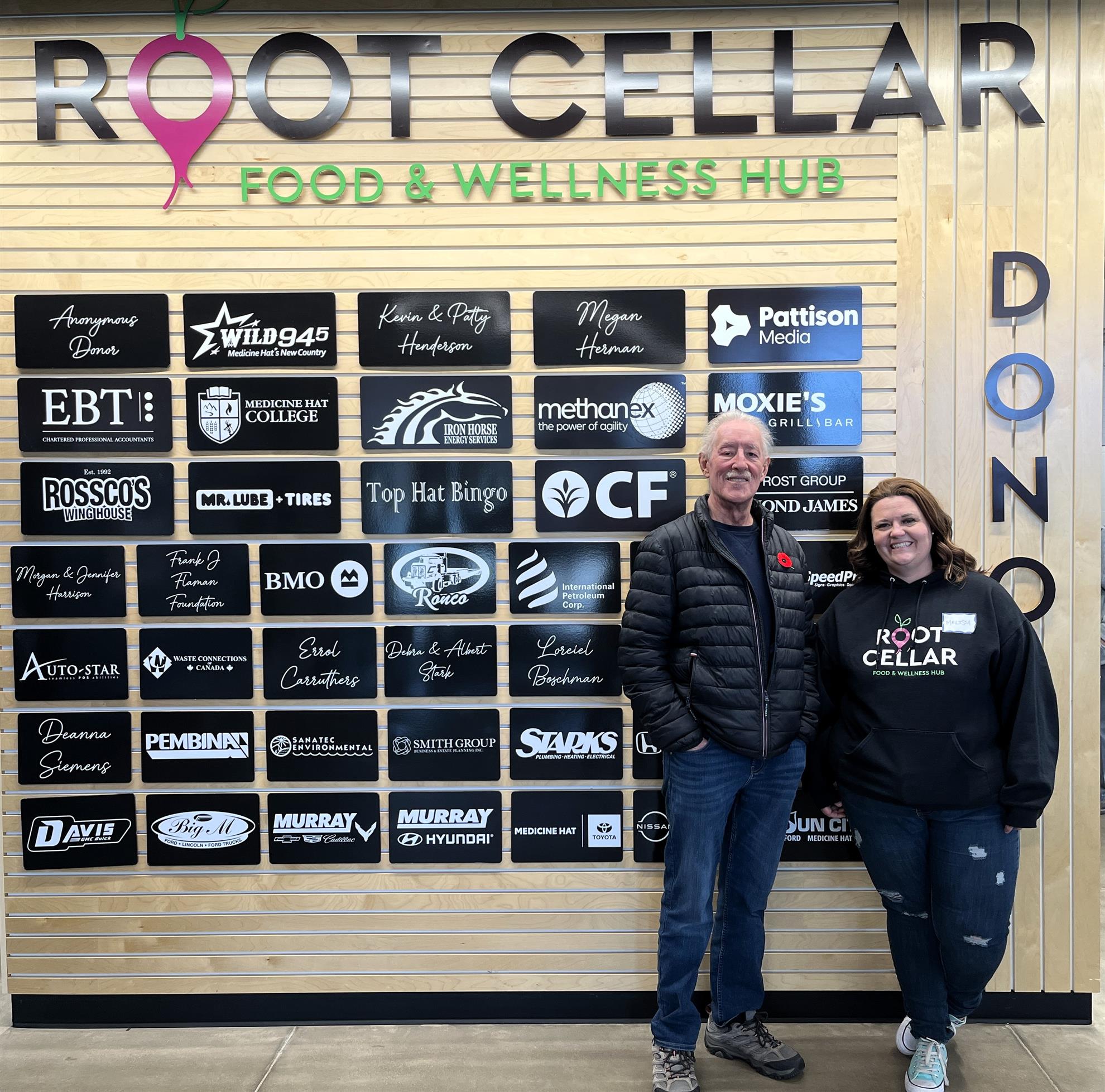
The annual budget of the Root Cellar is $1.6m.
No money is received from the City of Medicine Hat. Grant applications must be submitted for funding from the Province and Federal government.
We had a tour of the reception area, the waiting area (the creation of which was funded by the Co-op), a children’s play area (funded by Methanex) , the innovative ‘shopping’ area in which clients can select their groceries, vegetables, fruit, and frozen goods, we walked through the huge warehouse, saw the very large fridge and the freezer, popped outside to see the garden out the back, and lastly, viewed the large kitchen.
CLIENTS
Contrary to what some may think, the Root Cellar does not serve homeless people, other than offering refreshments, snacks and access to a washroom. There are other organizations in town who target the homeless.
So hunger exists in our community? Melissa said that in 2019, they were feeding about 900 people. Today, that number is over 4,000. Reasons include the COVID pandemic, loss of jobs, and increasingly, the high cost of living.
The Root Cellar deals with three broad categories of people: those on a fixed income who cannot make ends meet, those who just need help on occasion (e.g. seasonal workers and people who experience a crisis in their lives), and, in the middle, a group that is targeted by the staff: those living in generational poverty who think the Root Cellar is the place from which they get all their necessities. This group is targeted with case management and programs and services of different sorts.
SERVICES
Also contrary to what some may think, the Root Cellar does not just make food available indefinitely, creating dependency. The Emergency Food Pantry is a much-needed service, headed by two social workers and other staff, who make a pack of food items available to those who are in dire straits. But the next time these people arrive at the Root Cellar, they have a conversation with a social worker who looks into their circumstances with them, and who then attempts to assist the person/family getting onto a path to self-sufficiency. They are linked to the community resources they need, e.g. mental health services, the goal being to ‘get them out of the system’.
The food in the Emergency Food Pantry is purchased with donor dollars. Other food on the shelves, from which clients select, comes from donations, including from Red Marble Farms, the many Hutterite communities, food drives, and the Food Collab program (a partnership with grocery stores and other not-for-profit organizations).
Brown bag lunches are prepared for upward of 1,500 school children, Mondays to Fridays, in the three school districts. It is community funded and costs about $300,000-$500,000 per year.
There is a community desk, through which clients have access to the Women’s Shelter, the YMCA, the Mustard Seed, and other organizations, as per their needs and their goals.
The gardens behind the building serve several purposes, including teaching children and families where their food comes from. Gardening classes are offered and there is a Gardening Club.
Root Cellar has a well-equipped kitchen in which a successful family program called ‘Food First’, was offered, helping families become self-sufficient. A range of services were offered to 10 families at a time, by different organizations, over 12 weeks, including learning about shopping and developing basic cooking skills. However, there are so many people currently in crisis, that the decision was made to shelve this $6,000 cost per family program to enable the Root Cellar to serve the 4,000+ who need help. The kitchen is now used by different organizations for different purposes.

STAFF AND VOLUNTEERS
The services of the Root Cellar are provided by a team of 15 staff members: the ED, coordinators (of Events, Volunteers, Donations, Emergency Food Program, Programs), Financial manager, Operations manager, Warehouse manager, several assistants, and two drivers.
Volunteers team up with the staff in a range of ways to offer the different services.
HOW TO SUPPORT THE ROOT CELLAR
Rotarians and friends, there are many ways to support the Root Cellar:
Donations: Cash and food (basics for the Emergency Food Program and ‘wish list’ items to make ‘shopping’ at the Root Cellar more exciting. See details on the website).
Volunteering: Packing Brown Bag lunches for school children; assisting in the warehouse; sorting food; portioning food; supporting the Emergency Food Program; serving on the Root Cellar Board.
Melissa, kudos and respect to you, your staff and volunteers. The Medicine Hat Root Cellar is exemplary regarding not only the range of much-needed services offered, but the creative, collaborative and effective way in which these services are developed, managed, and offered.